year
2022
co-author
Kezia Nathania
published
Abstract
Spatialising Time: Perceiving Multiple Layers of Time in the Narrative Environment
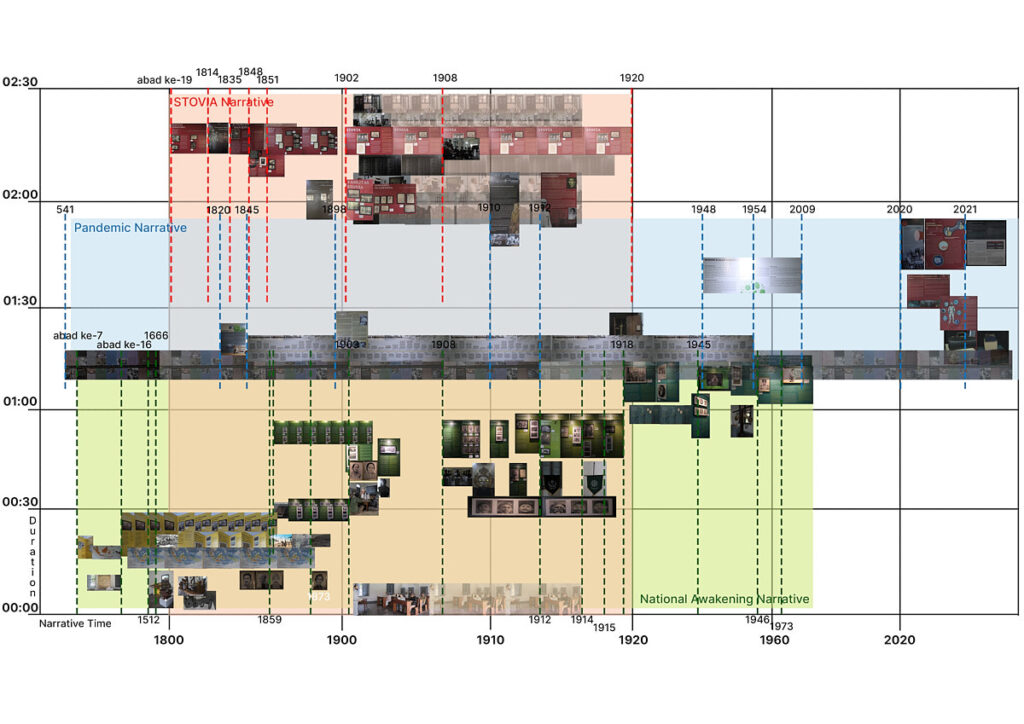
There is no escape from time; that includes architecture which dominantly discusses the space. This paper aims to explore more about our understanding of the various times within space and its corresponding stories. Notably, this study looks at the context of the narrative environment where stories are imbued in space to enhance their engagement with the audience. Time in a narrative is presented through the narrated time and the real-world time where the audience of the narrative perceives it. Both types of time can be overlapped, whether the audience is consciously aware of that or not. Two case studies are conducted to understand overlapping multiple time layers in the narrative environments. Through a personal visit to Museum Kebangkitan Nasional and participation in the Secret Cinema event, data is gathered by taking photos, looking for official publications, and time-count during the experience. It is found that time can be spatialised through the explicit transition of graphics, a play of lighting, and overall spatial organisation that affect the pace and duration of the narrative in space.
Nathania, K., & Wahid, A. R. (2022). Spatialising time: Perceiving multiple layers of time in the narrative environment. ARSNET, 2(2), 108–123. https://doi.org/10.7454/arsnet.v2i2.19